
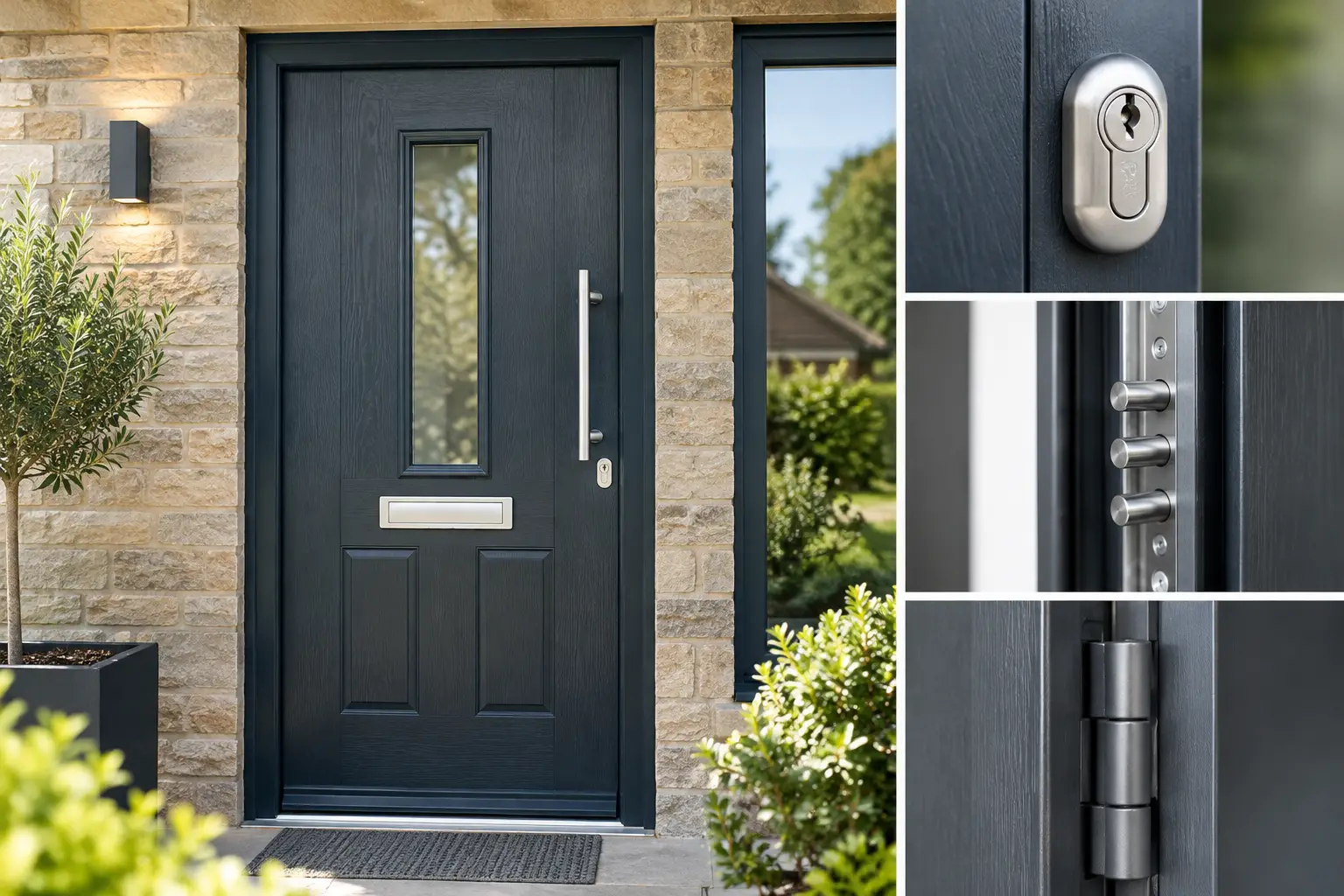
A front door should make a home feel welcoming to family and firmly closed to everyone else. That is where composite door security features earn their place. A well-specified composite door combines a dense, reinforced construction with quality locks, protected hinges and a frame fitted properly into the opening. The result is not simply a smarter entrance – it is a meaningful upgrade in everyday peace of mind.
For homeowners across Cumbria, security also needs to stand up to wind, rain, cold weather and years of regular use. A door can have an impressive-looking lock, but it will only perform as intended when the door leaf, frame, hardware and installation all work as one system.
What makes a composite door harder to force?
Unlike a basic timber door or a lightweight uPVC panel, a composite door is built from several materials chosen for strength, stability and insulation. The exact make-up varies by manufacturer, but commonly includes a solid or high-density core, reinforced sections and a durable outer skin. This layered construction creates a thick, weighty door that resists warping, splitting and impact far better than a hollow or poorly maintained alternative.
That strength matters because forced entry is rarely about one dramatic blow. An intruder may try to push, twist, lever or repeatedly strike a weak point. A solid door slab gives them far less to work with, while the frame and locking points spread resistance around the opening rather than relying on one central latch.
Security should never be judged by the door slab alone. A premium door fitted into a tired, weak frame, or installed with gaps and poor fixings, is not delivering the protection you are paying for. The best results come from a complete door set designed and fitted together.
The composite door security features that matter most
Multi-point locking
A multi-point locking system is one of the biggest practical advantages of a modern composite door. Instead of securing only at the handle, it locks at several points along the edge of the door. Depending on the system, these may include hooks, rollers, bolts or deadbolts that engage with reinforced keeps in the frame.
When the handle is lifted and the key turned, the door is pulled tightly into the frame and secured at multiple heights. This makes it much more difficult to force the door open by levering near one point. It also improves the weather seal, helping to reduce draughts alongside improving security.
Not every multi-point lock is identical. The number of locking points can be useful, but the type, positioning and quality of the mechanism matter more than a headline number. A professionally fitted system with well-aligned keeps is far more valuable than extra locking points that do not engage cleanly.
An anti-snap cylinder
The cylinder is the part of the lock where you insert your key, and it deserves close attention. On doors using euro cylinders, a standard cylinder can be vulnerable to lock snapping if it projects too far from the handle or lacks modern protection.
An anti-snap cylinder is designed to break in a controlled way if attacked, leaving the internal locking mechanism protected. Look for a cylinder tested to recognised standards, such as TS007. A three-star cylinder can provide a high level of protection on its own, while a one-star cylinder is commonly paired with a two-star security handle to achieve the same three-star rating.
This is a detail worth discussing before ordering. The lock cylinder is relatively small, but it is one of the most targeted parts of any entrance door. It should sit correctly within the handle and not protrude unnecessarily beyond it.
Security handles and reinforced hardware
A good handle does more than improve the appearance of the door. Security handles can shield the cylinder from gripping, drilling and pulling attacks, while reinforced backplates add protection around the lock area.
Handle quality is particularly important on a busy family entrance. Flimsy hardware can loosen over time, affecting both the look and the operation of the lock. Choose furniture that feels solid, suits the colour and style of the door, and has the security rating to match the cylinder being used.
Hinges that cannot be easily attacked
Hinges are easy to overlook, especially on outward-opening doors. A secure door should use strong hinges appropriate to its weight, with hinge bolts, dog bolts or security studs where required. These interlock with the frame when the door is closed, helping to prevent the hinge side being forced apart.
This is another reason to buy a complete, professionally specified door rather than focusing solely on the lock. Correct hinge selection and adjustment keep the door hanging square, which protects the security and weather performance over the long term.
Reinforced frames and secure keeps
The frame takes a great deal of pressure during an attempted forced entry. Composite door frames may include steel or other reinforcement in key areas, particularly around the lock keeps and hinges. The keeps themselves should be securely fixed into the reinforced frame, not merely screwed into a weak section of material.
A strong frame also helps the door continue to operate properly through changing temperatures and wet Cumbrian weather. If a door begins catching, dropping or requiring excessive force to lock, it needs adjustment. Leaving it that way can put extra strain on the mechanism and create avoidable weak points.
Glazed panels need proper protection too
Glazed composite doors bring welcome natural light into a hallway, and they can make even a small entrance feel brighter. They do not have to mean compromising on security, provided the glass and installation are specified correctly.
Toughened or laminated safety glass is the sensible choice for door glazing. Toughened glass is designed to break into small, less dangerous pieces, while laminated glass includes an interlayer that helps hold it together when broken. For security-conscious households, laminated glass can offer an extra delay against forced entry.
The design matters as well. A letterbox, cat flap or low glazed panel should not give someone a route to reach the inside handle or thumbturn. This does not mean every door needs to be completely solid, but it does mean the layout should be considered carefully. A door supplier should be able to advise on secure decorative glazing that still gives the entrance real kerb appeal.
Certification gives useful reassurance
When comparing composite doors, ask whether the complete door set is tested to PAS 24, a recognised UK security standard for external doors. PAS 24 testing assesses resistance to methods of attack commonly used in opportunistic break-ins, rather than simply testing individual components in isolation.
You may also see Secured by Design requirements referenced on certain door specifications. This police-backed initiative sets standards for products used in homes where crime prevention is a priority. These ratings can be particularly useful when you are comparing like-for-like quotations, or when a landlord, developer or insurer has specific requirements.
Certification is valuable, but it is not a substitute for sensible specification. A PAS 24 door still needs the right cylinder, glazing choice and professional fitting for the property in question.
Why fitting quality is part of the security package
A composite door is only as secure as the way it is installed. The frame must be fixed soundly to the structure of the home, packed correctly, levelled accurately and sealed neatly. The door then needs careful adjustment so every locking point engages fully without needing to force the handle.
Poor fitting can leave gaps, cause a door to drop, make locks stiff or allow movement in the frame. It can also harm thermal performance, allowing cold air and rain to find their way indoors. Professional installation protects your investment on both fronts: a secure entrance and a warmer, more comfortable home.
At Cumbria Superglaze, the focus is on complete door upgrades rather than a quick cosmetic change. An experienced fitting team can check the condition of the opening, advise on hardware and glazing, and make sure the finished door closes, locks and seals as it should.
Choosing the right level of security for your home
Most households benefit from a solid composite door, multi-point lock, anti-snap cylinder, quality security handle and correctly fitted reinforced frame. That is an excellent baseline for a main entrance, whether you live in a town property, a rural home or a busy family house.
Higher-specification options may be worthwhile if the door is in a secluded location, opens onto a side passage, contains extensive glazing, or if you simply want added reassurance. A door alarm, external lighting and visible security measures can complement the door itself, but they should not be used to compensate for weak hardware.
The best choice balances security, insulation, style and budget. You do not need a fortress-like front door to protect your home well. You need a properly made, properly fitted door with the right security details built in from the start. Ask to see the lock and hardware specification before you decide, and you will know exactly what is standing between your home and the outside.


